Dubai DXB Terminal Guide 2026: Airlines by Terminal and Connections
Dubai DXB terminal guide: which airlines use T1, T2 and T3 as of October 2026, how the terminals connect, shuttle times and layover length.
This Dubai DXB terminal guide covers which airlines use each terminal and how to connect between them. Dubai International (DXB) has three terminals. As of October 2026, Terminal 3 is Emirates, Terminal 1 handles most other international airlines, and Terminal 2 is flydubai plus regional and low-cost carriers. T1 and T3 are linked airside. T2 is set apart from the other two main buildings, so a connection involving T2 needs noticeably more time.
Dubai DXB terminal guide: which airlines use T1, T2 and T3
DXB handled more than 95.2 million passengers in 2025. It was the world's busiest airport by international passenger traffic as of 2025.
The table below names only Emirates and flydubai. Those are the only airline assignments we could confirm from the airport's own transfer information as of October 2026. We don't list the individual airlines in Terminal 1 here. For that, check the terminal and airline listings on dubaiairports.ae.
| Terminal | Who uses it (as of October 2026) | Gates |
|---|---|---|
| Terminal 3 | Emirates, plus Emirates-marketed flydubai flights that use T3 | Concourses A, B and C |
| Terminal 1 | Most other international airlines (see dubaiairports.ae for the list) | Concourse D (the "D Gates") |
| Terminal 2 | flydubai and regional or low-cost carriers | F Gates |
Codeshares need checking, not guessing. A codeshare is a flight sold under one airline's flight number but flown by another. Some flydubai-operated flights sold by Emirates use T3, Emirates' terminal. If you're flying flydubai, don't assume you'll be in T2.
How to find your airline's terminal:
- Look at your booking for the "operated by…" line. This tells you which airline is actually flying the plane, but it doesn't settle the terminal on its own.
- Check your boarding pass. It usually shows the departure terminal.
- Check the airport's own site, dubaiairports.ae, shortly before you fly. Terminal assignments change.
- On the day, our live flight status page shows the terminal and gate for your flight.
Departing from Dubai rather than connecting? Check-in and bag-drop opening and closing times are set by each airline and aren't covered in this guide. Check your airline's website for its times at DXB.
How the terminals connect
Within Terminal 3, you walk between the B and C Gates and take an airport train to the A Gates.
Dubai Airports describes T1 and T3 as linked airside, meaning inside the secure area. It says Terminal 1's D Gates are reached by a short airport train ride.
Marhaba, an airport-services company owned by the Emirates Group, separately lists a free T1–T3 inter-terminal shuttle bus. Neither source says which of the two a connecting passenger will be directed to, or whether that bus stays airside. Treat the train as the route the airport describes, and confirm on the day if you're sent to a bus.
The transfer times below are Marhaba's figures, as of October 2026. Re-check transfer details on dubaiairports.ae before you fly.
| Transfer | How | Frequency | Typical travel time |
|---|---|---|---|
| T3 concourse to concourse (A, B, C) | Walk between B and C; airport train to A | Train frequency: check dubaiairports.ae | Up to 30 minutes |
| T1 ↔ T3 | Free inter-terminal shuttle bus (Marhaba). Dubai Airports also describes an airport train to the D Gates. | Bus every 30 minutes | Bus about 10 minutes |
| T1 ↔ T2 | Inter-terminal shuttle bus | Every 30 minutes, 24 hours | About 30–40 minutes |
| T2 ↔ T3 | Inter-terminal shuttle bus | Every 30 minutes, 24 hours | About 30–40 minutes |
Mind the 30-minute frequency. That figure is how often a bus leaves, not how long the ride takes. If you just miss a bus to or from T2, you may wait up to half an hour before the 30–40 minute ride even starts.
Dubai Airports advises confirming your cross-terminal route with your airline, or with one of the airport's Guest Experience Ambassadors when you arrive.
How long a connection to allow
As of October 2026, Marhaba recommends a layover of at least 1.5 to 2 hours for a connection at DXB. Its rough budget is about 20 minutes to get off the plane and 20 to 45 minutes to move between terminals. Transfer security comes on top of that.
Marhaba's 20–45 minutes is its general budget for moving between terminals. For T2 it's worth working out a cautious case from Marhaba's own bus figures as well:
- About 20 minutes to get off the plane.
- Up to 30 minutes waiting for the next shuttle bus, if you've just missed one.
- About 30–40 minutes on the bus. Take the longer end, 40.
20 minutes plus 30 minutes is 50 minutes. 50 minutes plus 40 minutes is 90 minutes. That is roughly 90 minutes before you even join the security line, and it isn't a true worst case: it leaves out queues and a late or full bus.
After that, you still need to clear security, walk to your gate and arrive before boarding closes. Each airline sets its own boarding cut-off.
A simple test: a T2 connection is too tight if it's shorter than about 90 minutes plus security plus your airline's boarding cut-off.
Our own suggestions, not official minimums:
- Same terminal, one ticket: aim for Marhaba's 1.5 to 2 hours. Your airline may sell you a shorter connection on one ticket. That can work, but it leaves less margin if your first flight is late.
- T1 to T3, or the reverse: allow at least two hours.
- Anything involving T2, on one ticket: allow at least 2 hours 30 minutes, and 3 hours if you can. Applying the test above: 2 hours 30 minutes is 150 minutes, and 150 minus our 90-minute cautious case leaves about an hour for security, the walk to your gate and the boarding cut-off. Three hours gives you a further half hour of slack.
- Separate tickets (a "self-transfer"): Marhaba says this can add about 90 minutes. If you have checked bags, you'll usually have to collect them and check in again, and collecting bags at DXB means passing UAE immigration. So you must be eligible to enter the UAE: visa-free, visa on arrival, or with a visa arranged before you travel (see "Visas" below). If you aren't, don't book a self-transfer through Dubai. And if the first flight is late, the second airline has no obligation to wait for you.
On separate tickets, a missed flight is usually your problem to fix. See Missed Connection on Separate Tickets: Who Pays and What to Do before you book one through Dubai. If your trip also connects in London, our Heathrow Connection Times 2026: Terminal Transfers and Real Minimums covers the same questions there.
Connecting step by step
- Follow the "Transfers" signs after you leave the plane. Don't follow "Arrivals" unless you're leaving the airport. If you're unsure, ask at a transfer desk or find a Guest Experience Ambassador.
- Go to a transfer desk if you don't have your onward boarding pass. Dedicated desks issue boarding passes for onward flights.
- Clear transfer security. Assume the standard 100 ml liquids rule still applies. Dubai Airports has trialled newer scanners meant to let passengers keep larger liquids and laptops in their bags. As of a September 2025 report, no rollout date had been set.
- Watch your duty-free. Singapore Airlines' guidance for Dubai says duty-free liquids bought at airports outside Dubai may be confiscated at the gate when you connect there. Liquids bought on the day of travel after the boarding-card checkpoint are allowed. Either way, keep purchases sealed in a clear bag with the receipt until you reach your final destination.
- Check the departures screens for your gate. Then allow time for the train or bus if your gate is in another concourse or terminal.
Leaving the airport between flights
With a long layover you may want to see the city. One layover guide suggests at least about 6 hours between international flights, and around 8 hours to be comfortable. It also suggests allowing up to 45 minutes for immigration on arrival, and being back at security two hours before departure.
Visas. Some nationalities can enter the UAE without arranging anything in advance. As of October 2026, US citizens get a free visitor visa on arrival. It is usually stated as 30 days, though some sources say 90. The passport must be valid for at least six months beyond entry and have one blank page, and emergency passports are not accepted. Our guide to the six-month passport rule explains how that's counted.
Other travelers may need a transit visa. Only UAE airlines can sponsor one: Emirates, Etihad, flydubai and Air Arabia. It must be approved before you arrive.
As of October 2026, Emirates lists two options on its UAE visa page. A 48-hour transit visa costs USD 10, and a 96-hour transit visa costs USD 49. Both prices include VAT. Both visas are non-refundable and can't be extended, and they're valid only for onward travel on Emirates or its codeshares. Other sources quote different fees for the 96-hour visa, so confirm on Emirates' site.
Check your own nationality with our entry-requirements and passport-validity checker. For which hubs let you stay airside without a visa, see Transit Visa Rules by Hub (2026): Where You Can Stay Airside.
Getting into town. The Dubai Metro Red Line has stations at Terminal 1 and Terminal 3, reached directly from arrivals. You can buy Nol cards (the metro's ticket cards) at machines and ticket offices in both terminals.
Terminal 2 is not on the Red Line. You can connect to T2 from a Green Line station near the Airport Free Zone, and RTA buses stop opposite T2: Wikipedia lists routes 13B, 20, C26, N30, 31 and 43 as of October 2026. Check rta.ae for the current route and journey time before relying on it.
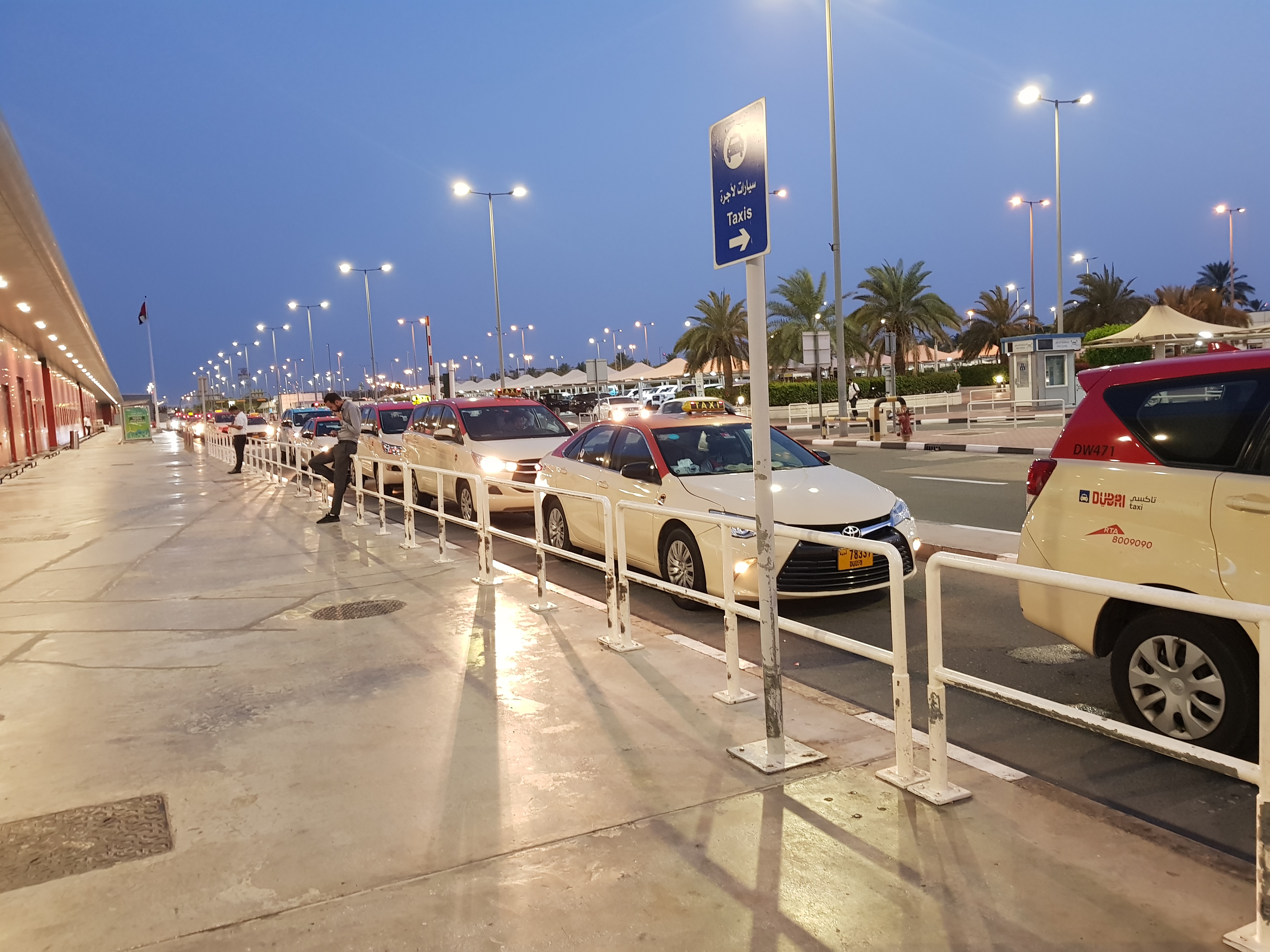
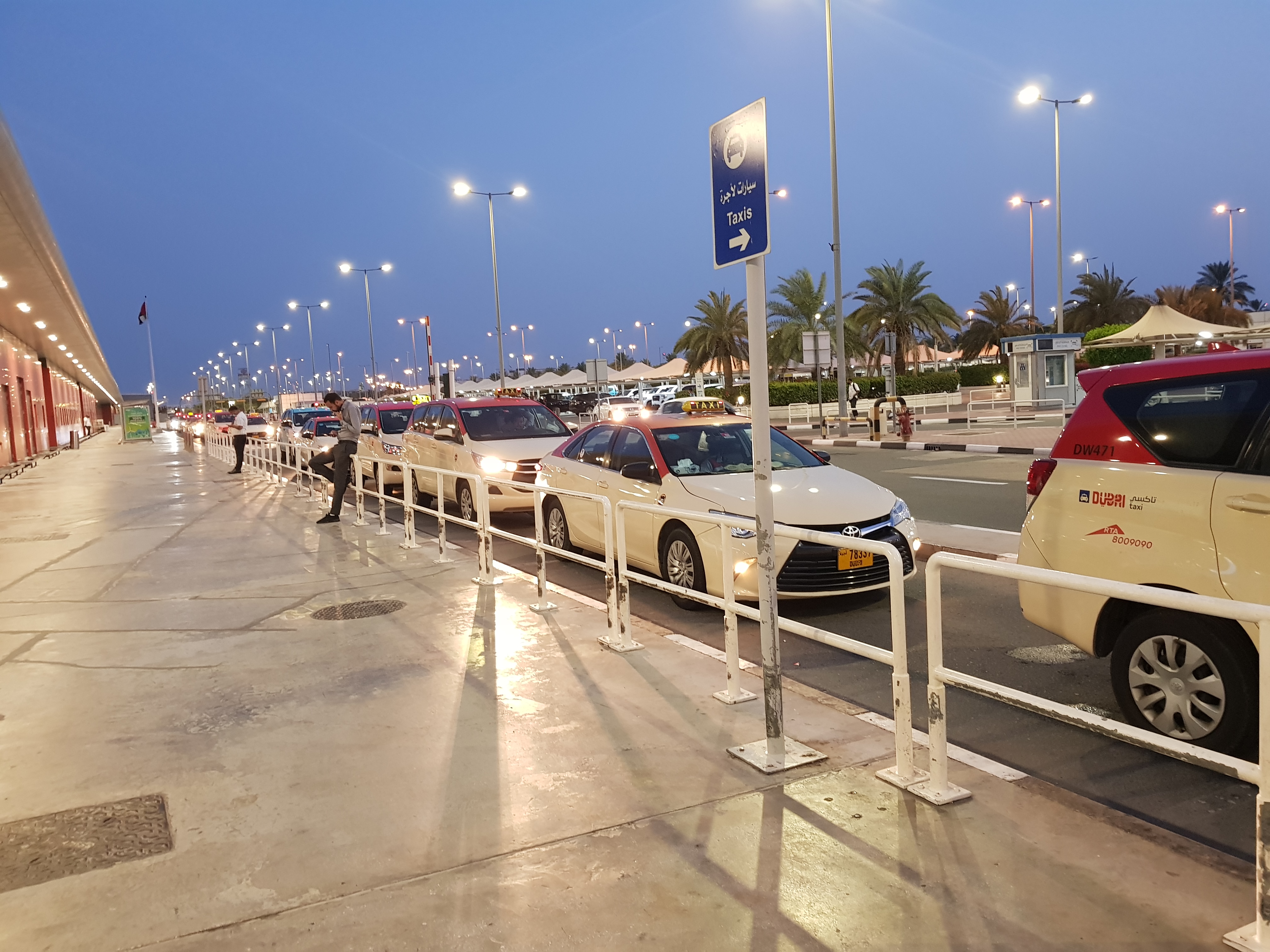
Metro hours vary by day. As of October 2026, Sunday service starts later than other days, at 08:00 instead of 05:00. Check rta.ae, the transport authority's site, for current hours and fares before relying on an early train. Taxis run 24 hours from arrivals at every terminal.
For hotels, sightseeing times and Emirates' Dubai Connect hotel offer, read our Dubai Layover Guide: Transit Visas, Sleep Pods, Leaving DXB.
Sleeping and lounges by terminal
If you're staying airside (inside the secure departures area), what's available depends on your terminal:
- Terminal 3: Sleepover lounges (formerly called "sleep 'n fly") in the A, B and C Gates. They offer pods and private cabins, with showers at some locations. The Dubai International Hotel is also airside in T3 and sells short stays.
- Terminal 1: a Sleepover lounge in the D Gates. We couldn't confirm an airside hotel in T1, so plan on lounges or pods.
- Sleepover prices: typically from about AED 65 per hour, with cabins costing more. This comes from a third-party layover guide, so check current rates before you go.
- Pay-per-visit lounges: as of October 2026, Marhaba lounges sell walk-in access from AED 195 (roughly $53), typically for a two-hour visit.
One third-party layover guide says sleep facilities get busy roughly between 02:00 and 04:00, so if you'll be there in the small hours, booking ahead is sensible. Prices and hours change, so check dubaiairports.ae. For general advice on lounge access, see our travel services guides.
Frequently asked questions
Which terminal does Emirates use at Dubai?
Emirates uses Terminal 3, across Concourses A, B and C, as of October 2026. Some flydubai flights sold under an Emirates flight number also use T3. Check your boarding pass, dubaiairports.ae and our flight status page to be sure.
Is 90 minutes enough to connect at DXB?
Ninety minutes is the low end of Marhaba's recommended 1.5 to 2 hours. It can work for a same-terminal connection on a single ticket, but it leaves little margin. For a connection to or from Terminal 2, our cautious case is about 90 minutes before you even reach security: getting off the plane, waiting for the bus and riding it. That's why we suggest at least 2 hours 30 minutes for T2.
Do I need a visa to change terminals in Dubai?
For a T1–T3 connection on one ticket: Dubai Airports describes the two terminals as linked airside (inside the secure area), with a short airport train to T1's D Gates, and transfer desks issue onward boarding passes, so you don't go through immigration. If your connection involves T2, or you're directed to a shuttle bus, ask your airline before you book, or a transfer desk on arrival, whether your route stays airside.
You will pass UAE immigration if you leave the airport, and also if you're on separate tickets and have to collect checked bags and check in again: bag collection is landside. Either way you must be able to enter the UAE, visa-free, on a visa on arrival, or with a visa arranged in advance, depending on your nationality. Check our entry-requirements checker and Transit Visa Rules by Hub (2026): Where You Can Stay Airside.