Guides · Airports
Delhi Airport T1 to T3 Transfer 2026: Time, Transport, E-Ticket Rule
Delhi airport T1 to T3 transfer (Oct 2026): 90 minutes on one ticket, 3 hours on separate tickets. Shuttle, taxi, metro and the e-ticket entry rule.
A Delhi airport T1 to T3 transfer means crossing about 8 km between two terminals at Indira Gandhi International (IGI) Airport, with no walkway or airside connection between them. You travel by a shuttle bus (free for connecting passengers) or by taxi. As of October 2026, allow at least 90 minutes if both flights are on one ticket and your bags are checked through. Allow at least 3 hours if you are on separate tickets.
This guide assumes you land on a domestic flight at T1 and leave on an international flight from T3.
Before you get into a shuttle, make sure you can get back into a terminal. At Delhi, guards at the door only admit people flying that day, and they want to see a ticket and photo ID.
Which terminal are you actually using?
As of October 2026, Delhi has three passenger terminals:
- T1: domestic flights only.
- T2: domestic flights only. It sits next to T3 and connects to it by an elevated walkway.
- T3: all international flights, plus some domestic ones.
Read this before the airline list. Delhi reshuffled its terminals in April 2025 and again in October 2025. One 2026 source reports that another reshuffle was planned for October 2026, but it gives no details, and we have not been able to confirm it. The allocations below were announced for 26 October 2025 and have not been re-verified for 2026. Use them as a starting point, not a promise.
Allocations announced for 26 October 2025:
- IndiGo: flights numbered 6E 2000–2999 use T2. Flights numbered 6E 5000–5999 and all international flights use T3. All other IndiGo domestic flights use T1.
- Air India: some domestic flights use T2. These carry four-digit numbers starting with 1, such as AI1737. Other domestic flights and all international flights use T3.
- Air India Express: domestic flights use T1. International flights use T3.
- SpiceJet and Akasa Air: T1. One 2026 guide places some Akasa flights at T2.
The terminal printed on your boarding pass or shown in the airline's app is the one that counts. You can confirm it, along with gate and delay status, on our live flight status page. Our guide on how to read flight status explains what each field means. Also check the airline's own Delhi terminal notice and the airport's terminal page at newdelhiairport.in.
Getting from T1 to T3: your options
There is no airside link between T1 and T3. "Airside" means the secure area beyond security screening. Every terminal change means leaving the secure area, traveling by road, and going through security again at the other end.
| Option | Typical cost (as of Oct 2026) | Typical time | Best for |
|---|---|---|---|
| DIAL inter-terminal shuttle | Free for connecting passengers holding an onward boarding pass; one source says others pay a small fee | Wait plus a reported 10–15 min drive; plan on roughly 30–45 min, longer at peak | Connecting travelers who already have the onward boarding pass |
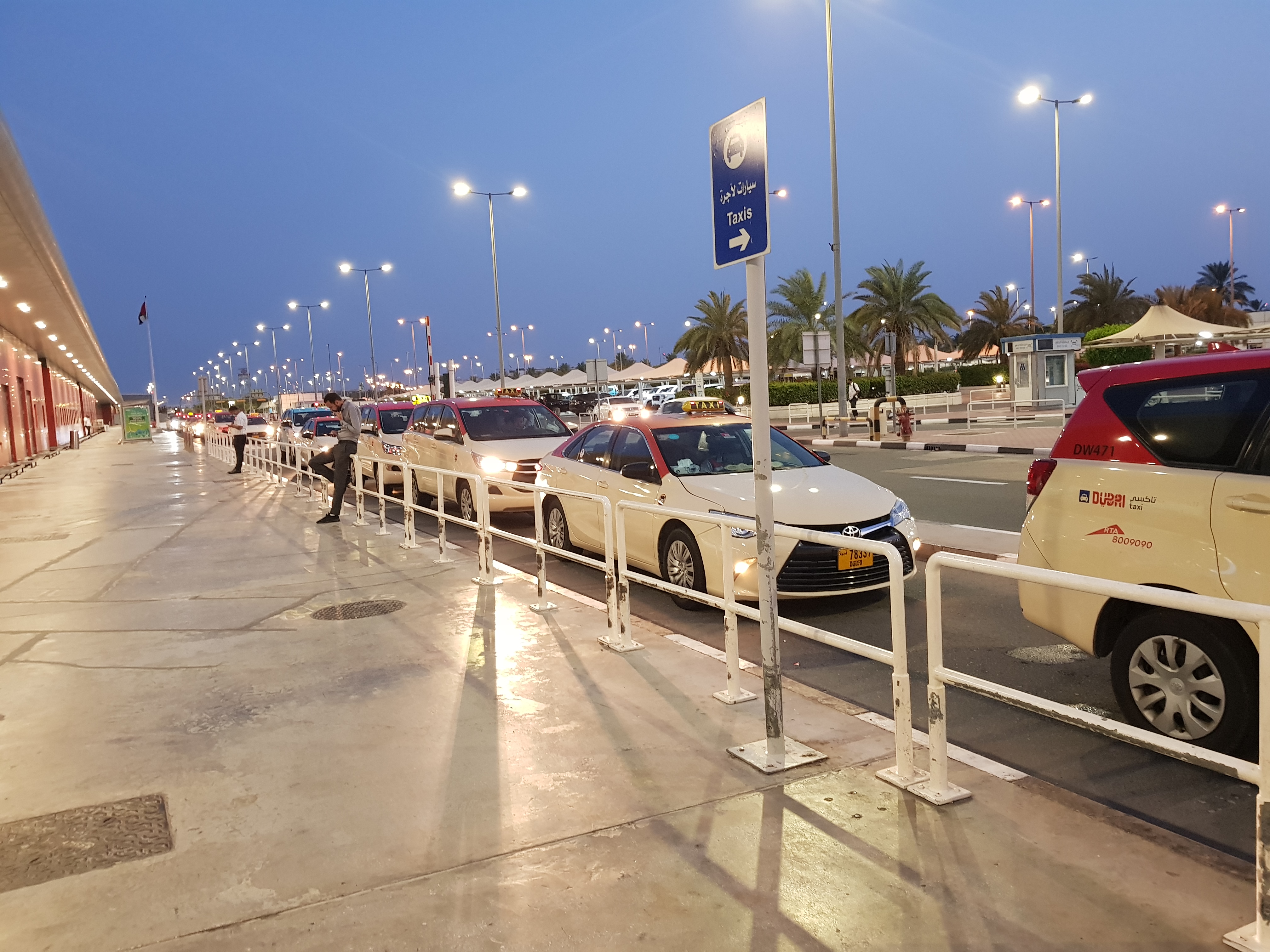
| Prepaid taxi or auto-rickshaw from the arrivals booth | Reported at roughly INR 150–250 | Reportedly 10–15 min drive in light traffic | Tight connections, heavy bags, separate tickets |
| App cab (Uber, Ola) | Varies; early-morning surge fares reportedly reach INR 400–700 | Similar to a taxi, plus pickup wait; a reported airport access fee may be charged on top of the fare | When the taxi booth queue is long |
| Metro | No single published fare; check delhimetrorail.com | Not published; two interchanges | Not recommended for this trip |
The shuttle is run by Delhi International Airport Ltd (DIAL), the airport operator. Air India's October 2025 announcement says DIAL runs it about every 10 minutes. Other 2026 guides report 15–20 minutes between buses, with longer waits at busy times.
Pickup points:
- At T3, the stop is reported to be near the arrivals forecourt (the road area outside arrivals).
- At T1, it is reported to be under the terminal flyover.
Ask airport staff for the exact stop when you land. DIAL's inter-terminal commute page is the place to confirm current timings and who rides free.
Taxis cost a little, but they take the bus wait out of the equation. On a separate-ticket connection, that certainty is often worth paying for.
The metro is a poor choice for this trip. The Airport Express Line stops at T3 but not at T1 or T2. The Magenta Line stops at T1, but it does not go to T3. To ride between them you would have to:
- Take the Magenta Line from T1 to Hauz Khas.
- Change to the Yellow Line and ride to New Delhi.
- Change to the Airport Express and ride to T3.
That is two changes with luggage, and there is no published total journey time. Use the metro to get between the city and the airport, not between terminals. Current fares are on delhimetrorail.com.
If you are going between T2 and T3, the trip is much easier. It is a 10–15 minute outdoor walk on the elevated walkway. Air India says a buggy is available for passengers with reduced mobility.
How much time to allow
The time you need depends mostly on one question: did you buy both flights on one ticket, or on separate tickets?
One ticket, bags checked through. "Checked through" means your bags are tagged to your final destination and the airline moves them between terminals for you. You still take the shuttle, clear security again and go through passport control at T3. If you hold both boarding passes, you should be able to skip baggage claim and check-in. As of October 2026, plan on at least 90 minutes for the whole transfer, from landing at T1 to clearing passport control at T3. Air India says connecting passengers holding a boarding pass for the onward flight get the inter-terminal transfer, and checked-through bags are moved for them.
Separate tickets. You are on your own, and you have to:
- Leave the plane at T1.
- Wait for your bags at baggage claim.
- Get to T3. Air India says connecting passengers with an onward boarding pass ride the shuttle free; one travel guide reports a small fee for everyone else. It isn't clear whether a separate-ticket traveler counts as "connecting", so ask the shuttle staff or check DIAL's inter-terminal commute page, and budget for a taxi or a possible fee.
- Get through the entry check at the T3 door.
- Check in and drop your bags again.
- Clear international security and passport control (called immigration).
Published guides disagree on how long this takes. Estimates range from 2–2.5 hours to a cautious 4–5 hours. As of October 2026, a sensible floor is at least 3 hours, and more for evening departures. T3's departure immigration is reportedly busiest in the evening, when flights to Europe and North America leave. One guide uses a 60-minute immigration queue as a worst case.
A worked example. Say you land at T1 at 17:30 on a separate ticket and your international flight leaves T3 at 21:00. That is 3 hours 30 minutes, only just above the 3-hour floor, and it falls in the evening peak. At peak, one guide puts the shuttle wait and drive at 45–60 minutes, and another uses a 60-minute immigration queue as its worst case. Those two alone take up to 2 hours of your 3½, before you have collected your bag at T1 or checked in again at T3, and no source times either of those. That leaves little margin before boarding. One late inbound flight or a slow bag would break it. For an evening departure on separate tickets, a longer gap is the safer choice. Just note that if your airline only lets you into T3 a set time before departure (see ANA's 4-hour rule below), arriving very early means waiting outside.
If the first flight runs late on separate tickets, the second airline has no obligation to wait for you or rebook you. Our guide to missed connections on separate tickets explains who pays and what to do. In short, a longer layover usually costs far less than a new long-haul ticket bought on the day.
For passport validity and entry requirements at your destination, check our travel documents page. If your trip continues through London, our guide to Heathrow connection times covers that airport's terminal transfers.
The e-ticket rule at the terminal door
Delhi terminals admit only passengers flying that day. Officers from the Central Industrial Security Force (CISF), which guards Indian airports, check every person at the entrance.
- Domestic departures: you show a ticket or boarding pass plus government photo ID. A passport is the obvious choice for foreign visitors.
- International departures: officers check your passport and your ticket or boarding pass.
ANA, the Japanese airline, publishes more detailed Delhi guidance for its own passengers. Other airlines may differ, so check yours. According to ANA:
- The itinerary or receipt you show must be for that day's flight and must carry a barcode or 2D barcode.
- A paper printout or an electronic copy is acceptable.
- Entry opens 4 hours before departure, so if you get to T3 earlier than that you may have to wait outside.
- Adults dropping off minors cannot go in.
On a separate-ticket connection, the onward e-ticket is your key to T3. Download it to your phone so it works offline, and carry a printout as a backup. Don't count on airport Wi-Fi or roaming data working at the door.
ANA also says passengers need a paper boarding pass to leave India, even after checking in online. This varies by airline. If your airline offers to print one at check-in, take it.
Saving time at each step
- Ask about through-checking at your first check-in. If both flights are on one ticket, ask the agent at your origin airport to confirm that your bags are tagged all the way to your final destination. The tag should show the final airport code, not DEL. If they stop at Delhi, you have to collect them at T1 and check them in again at T3, which turns a one-ticket connection into something closer to a separate-ticket one.
- Confirm both terminals the day before. Delhi allocations have changed twice since April 2025. Check the terminal on each boarding pass or in each airline's app rather than relying on a booking made months ago.
- DigiYatra. DigiYatra is India's facial-recognition entry system, available at T1, T2 and T3. It needs a one-time enrollment in the app linked to Aadhaar, India's national ID number, so in our reading it is mainly useful to Indian residents. The time saving reported for it is at T1 entry, on the domestic side; don't count on it to shorten the international leg at T3. Visitors without Aadhaar should plan on the standard queues.
- If your bag doesn't arrive. Our general travel services guides cover what to do about lost bags. For the claim limits and paperwork, see Airline Lost My Bag: Montreal Convention Limits, PIR and Claims.
Frequently asked questions
Can I walk from Terminal 1 to Terminal 3 at Delhi airport?
No. The terminals are about 8 km apart, so you need the shuttle bus or a taxi. The only walkable connection at Delhi is between T2 and T3.
Is the Delhi airport inter-terminal shuttle free?
Air India says it is free for connecting passengers who hold a boarding pass for the onward flight. One travel guide reports a small fee for everyone else. On separate tickets, ask the shuttle staff whether you can ride free, and have cash or a card ready for a fee or a taxi. Confirm current rules on DIAL's inter-terminal commute page.
How long does the Delhi T1 to T3 transfer take?
As of October 2026, allow at least 90 minutes on one ticket with bags checked through, and at least 3 hours on separate tickets, more for evening departures. The road trip alone is reported at 10–15 minutes in light traffic, but bus waits, bag reclaim, check-in, security and immigration take up most of the time.
Can I walk from Terminal 2 to Terminal 3?
Yes. An elevated walkway links them, and the walk is about 10–15 minutes outdoors. Air India says a buggy is available for passengers with reduced mobility.
Will they let me into T3 if I only have my booking on my phone?
ANA's guidance says electronic copies are accepted if the booking is for that day's flight and shows a barcode, and you have your passport with you. Other airlines may set their own requirements, so check yours. Keep an offline copy and a printout in case your phone or data fails at the door.