Guides · Flying explained
Why Westbound Flights Take Longer: The Jet Stream, With Examples
Westbound flights take longer because they fly into the jet stream's headwinds. See how it works, real route times, and when the gap is biggest.
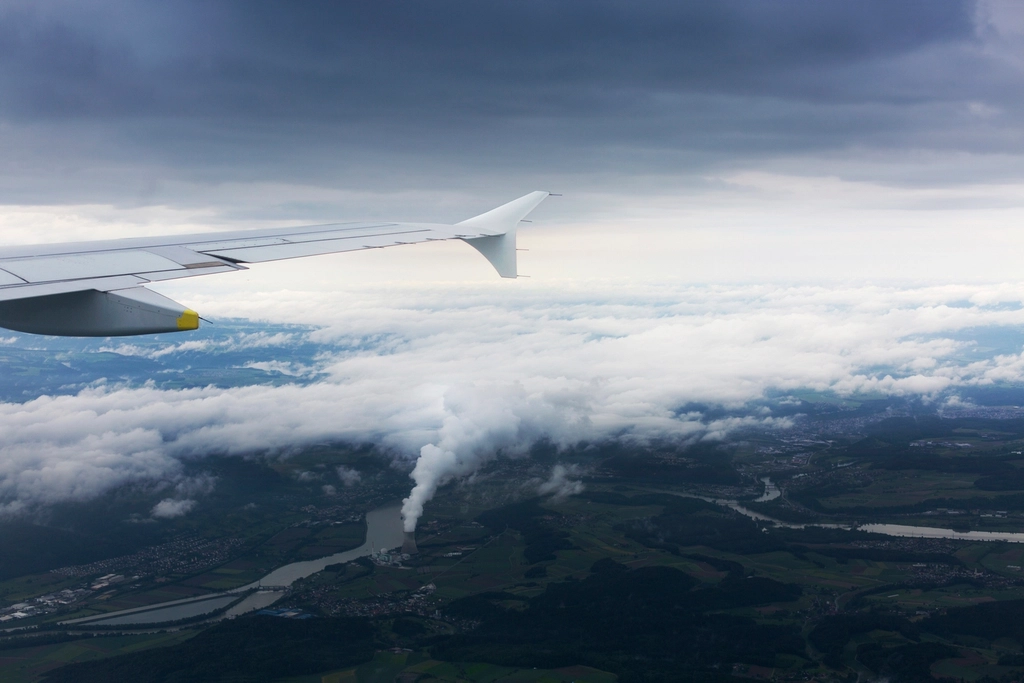
Westbound flights usually take longer because they fly into the jet stream. The jet stream is a band of fast wind high in the atmosphere that blows from west to east. Planes heading east get pushed along, and planes heading west push against it.
On a transatlantic route like New York to London, the difference is typically 45 to 75 minutes. On a US coast-to-coast flight it is usually about an hour. Most of that comes from the wind. The plane, the engines and the Earth's spin are not the cause.
What the jet stream actually is
The jet stream is a river of air roughly 30,000 to 40,000 feet up. That is the same altitude where airliners cruise. It forms where cold polar air meets warmer air further south. The temperature difference creates strong winds, and the Earth's rotation bends them so they flow from west to east.
Winds in the core of the jet stream are often 100 mph or more. In winter they can be much stronger, sometimes over 200 mph. The stream is not a straight line. It snakes north and south, shifts from day to day, and is a few hundred miles wide in places.
Two terms are worth knowing:
- Tailwind: wind blowing from behind the plane, in the same direction it's flying.
- Headwind: wind blowing toward the front of the plane, against its direction of travel.
Eastbound flights in the Northern Hemisphere often get tailwinds. Westbound flights often face headwinds.
Why westbound flights take longer: airspeed vs ground speed
A plane moves through the air, and the air itself is moving. That gives two different speeds:
- Airspeed is how fast the plane moves through the surrounding air. For a jetliner at cruise this is roughly the same in either direction.
- Ground speed is how fast the plane covers distance over the ground. This is what decides how long the trip takes.
Ground speed is airspeed plus a tailwind, or airspeed minus a headwind. The plane isn't working harder going east. It is sitting in air that is already moving the right way, like walking on an airport moving walkway.
Here is a simplified example for a single flight:
- Distance: 2,500 miles, roughly coast to coast across the US.
- Airspeed: 500 mph.
- Wind: 100 mph from the west.
Eastbound: 500 + 100 = 600 mph ground speed. 2,500 ÷ 600 = about 4.17 hours, or roughly 4 hours 10 minutes.
Westbound: 500 − 100 = 400 mph ground speed. 2,500 ÷ 400 = 6.25 hours, or 6 hours 15 minutes.
That is a gap of about two hours. The example exaggerates on purpose. It assumes a steady 100 mph wind blowing straight along the entire route, from takeoff to landing. Real flights rarely meet that, for three reasons:
- The wind is never that strong, or that well lined up, along the whole route.
- Climb and descent happen at lower altitudes, where winds are usually weaker.
- Westbound pilots deliberately route around the worst of it.
That is why the real-world gap on a coast-to-coast route is usually about an hour, not two.
The rule in words: the stronger the wind and the longer the route, the bigger the gap between eastbound and westbound times.
Real examples: westbound vs eastbound flight times
Scheduled times include taxiing and some buffer, so treat these as typical, not exact. They reflect typical schedules in 2026 and vary by airline, season and aircraft. Check your airline's timetable for your exact flight.
| Route | Eastbound | Typical scheduled time | Westbound | Typical scheduled time |
|---|---|---|---|---|
| New York (JFK) – London (LHR) | JFK → LHR | roughly 7 hours | LHR → JFK | roughly 8 hours |
| Los Angeles (LAX) – New York (JFK) | LAX → JFK | roughly 5 to 5½ hours | JFK → LAX | roughly 6 to 6½ hours |
| Tokyo (HND) – Los Angeles (LAX) | HND → LAX | roughly 10 hours | LAX → HND | roughly 11½ to 12 hours |
| Sydney (SYD) – Los Angeles (LAX) | SYD → LAX | roughly 13½ hours | LAX → SYD | roughly 15 hours |
The transatlantic and coast-to-coast gaps sit around an hour. The longest transpacific routes show a bigger gap, often 1½ hours or more, because the plane spends so many hours in the wind.
On transpacific routes, eastbound means flying from Asia toward America. Sydney to Los Angeles heads northeast, so it counts as eastbound too. The Southern Hemisphere has its own west-to-east jet stream, so eastbound flying is generally faster there as well.
The schedule shows block time, meaning the time from the plane leaving the gate to arriving at the gate. Departure and arrival times on your ticket are in local time, so time zones can make a flight look much shorter or longer than it is. To see the route map, distance and a realistic flying time for any pair of cities, use our route map and flying-time tool.
A famous extreme case: on 9 February 2020, during Storm Ciara, a British Airways 747 riding an unusually powerful jet stream flew from New York to London in about 4 hours 56 minutes. That is well over an hour faster than usual. Its ground speed was widely reported to have peaked at about 825 mph, while its airspeed stayed normal.
It's not the Earth's rotation (mostly)
A common belief is that westbound flights are slow because the Earth spins beneath you, or that flying west should be faster because the ground "comes to meet you." Neither is right.
The atmosphere spins along with the Earth, and so does the plane sitting in it. From the plane's point of view, the ground isn't racing past at 1,000 mph. If rotation alone mattered, every flight in one direction would be hours shorter, and they aren't.
Rotation does play an indirect part. It helps steer the winds into that west-to-east pattern, which is why the jet stream flows the way it does. But the thing that changes your flight time is the wind itself.
When the difference is biggest, and smallest
Winter is the big season. The temperature contrast between the poles and the tropics is greatest in winter, so the jet stream is stronger. Eastbound transatlantic flights sometimes land 30 minutes or more ahead of schedule, and westbound ones can run longer than usual. In summer the jet stream weakens and drifts north, and the gap narrows.
North-south routes barely notice it. A flight from Chicago to Miami, or from Europe to South Africa, crosses the jet stream instead of flying along it. The difference between the two directions is small.
Short flights see small differences. On a one-hour hop, even a strong headwind typically adds minutes, not the hour you might see on a long-haul route.
How airlines and pilots deal with it
Airline dispatchers plan each flight's route using that day's wind forecast. Eastbound flights try to ride the core of the jet stream for the biggest tailwind. Westbound flights try to avoid it, sometimes by flying a more northerly or southerly path, or a different altitude.
Over the North Atlantic, the main published routes (called the North Atlantic Tracks) are redrawn for each day's traffic, typically with one set for the daytime westbound flow and another for the overnight eastbound flow, partly to follow or dodge the jet stream. Combined with the curve of the Earth, this is why flight paths on the map can look oddly bent. Our guide on why flights don't fly in a straight line explains more.
Headwinds also mean the plane burns more fuel per mile. On the longest nonstop routes, strong headwinds can mean the airline has to carry fewer passengers, bags or cargo so the plane can take off with enough fuel. This is called a payload restriction.
What it means for your trip
- Expect the westbound leg to feel longer, because it is. Plan for roughly an extra hour on transatlantic and coast-to-coast flights heading west, and more on the longest transpacific routes, especially in winter.
- Early arrivals are common eastbound. Airlines build buffer into schedules, and a strong tailwind can eat it up. Allow for this if someone is picking you up, or check live flight status before leaving for the airport.
- Read status updates carefully. A westbound flight showing a later estimated arrival may simply be fighting headwinds rather than having a problem. Our guide on how to read a flight status explains what each update actually means.
- Leave more time for connections after a westbound flight in winter, when headwinds are strongest and least predictable. If you're booking separate tickets yourself, aim for at least 3 hours between flights, and longer if you have to clear customs, collect your bags and check them in again. On separate tickets, the second airline typically has no obligation to rebook you if the first flight runs late, so a generous buffer is your only protection. On the day, check the inbound flight's estimated arrival on live flight status before you land so you know whether to hurry. If a delay does cost you a connection on a single booking, our guide to your rights when a flight is cancelled or badly delayed explains what the airline typically owes you.
Frequently asked questions
Why is my flight home from Europe longer than my flight there?
If you live in North America, the flight home is westbound, against the jet stream. The headwind lowers the plane's ground speed, so the same distance takes longer, typically 45 to 75 minutes more on a transatlantic route.
Do planes fly faster eastbound?
Not through the air. Airspeed is about the same in both directions. The plane is faster over the ground eastbound because the air it's flying in is moving east, which adds to its speed.
Is it the same in the Southern Hemisphere?
Yes. The Southern Hemisphere has its own west-to-east jet stream, so eastbound flights there also tend to be quicker. That is one reason Sydney to Los Angeles is usually shorter than Los Angeles to Sydney.