Guides · Cruise & air
Best Airports for a Mediterranean Cruise: Barcelona, Rome, Athens, Venice
Which airport to fly into for a Mediterranean cruise from Barcelona, Rome (Civitavecchia), Athens or "Venice" — transfer times, costs and the traps.
The short answer: Barcelona → BCN. Rome → FCO, arriving the day before. Athens → ATH. "Venice" → it depends which port your ship actually uses: VCE for Marghera, Bologna (BLQ) for Ravenna, Trieste (TRS) or VCE for Trieste.
Barcelona is the easiest of the four — not because it's the shortest drive, but because there's one port, one terminal area, a fixed-fare taxi, and no ambiguity. "Rome" and "Venice" are where travelers get caught out. Rome's cruise port is Civitavecchia, about 40 miles from Fiumicino airport. Large ships no longer dock in Venice at all; your real port may be up to 2.5 hours by road from Venice's airport, and a different airport may be closer.
Here is how the four compare, as of October 2026. Before you book flights, check your cruise line's itinerary page, which names the actual port, and the port authority sites for Barcelona, Civitavecchia, Piraeus, Venice, Ravenna and Trieste.
Best airport for a Mediterranean cruise: the four ports compared
Distances are road miles from the airport listed. Times are typical and don't include traffic on busy sailing days. Costs are for a taxi or car unless noted.
| Marketed as | Fly into | Actual cruise port | Distance | Typical drive | Typical cost |
|---|---|---|---|---|---|
| Barcelona | BCN | Port of Barcelona (Moll Adossat) | ~9 miles | 20–30 min | €35–45 by taxi, incl. port supplement |
| Rome | FCO (Fiumicino) | Civitavecchia | ~40 miles | 60–90 min | €30–50 per person shared; €120–180 private |
| Athens | ATH | Piraeus | ~28 miles | 45–60 min | €55–65 taxi (fixed daytime fare) |
| Venice | VCE | Porto Marghera | ~8 miles | 20–30 min | Short taxi ride |
| Venice | BLQ (or VCE) | Ravenna (Porto Corsini) | ~50 miles from BLQ; ~90 from VCE | 60–75 min from BLQ; 2–2.5 hours from VCE | Cruise lines sell coach transfers from both |
| Venice | TRS (or VCE) | Trieste | ~25 miles from TRS; ~95 from VCE | 30–40 min from TRS; 1.75–2 hours from VCE | Check your cruise line |
The verdict: which airport is best
Ranked from easiest to hardest:
- Barcelona (BCN). One port, a 20–30 minute fixed-fare taxi, and nothing to get wrong.
- Athens (ATH). A fixed-fare taxi gets you to Piraeus in about an hour.
- Rome (FCO). Fine if you arrive the day before; the 60–90 minute transfer to Civitavecchia is the catch.
- "Venice." Distance isn't the reason this ranks last — Marghera is only about 8 miles from VCE. It ranks last because "Venice" can mean any of three ports, and the right airport depends on which one you sail from.
By situation:
- Light luggage: public transport is workable in Barcelona (Aerobús), Rome (train to Civitavecchia) and Athens (metro, with a 10–20 minute walk at the end). For Marghera, the port is a short taxi ride from VCE.
- A couple: in Rome, a shared shuttle is usually cheaper than a private transfer. Elsewhere, a taxi is simplest.
- A family or two couples: in Rome, get a private-transfer quote for your group size and luggage. It can come close to the shared price.
- A one-way itinerary: fly into the start port's airport and home from the end port's airport — for example, into BCN and home from FCO.
Barcelona: the straightforward one
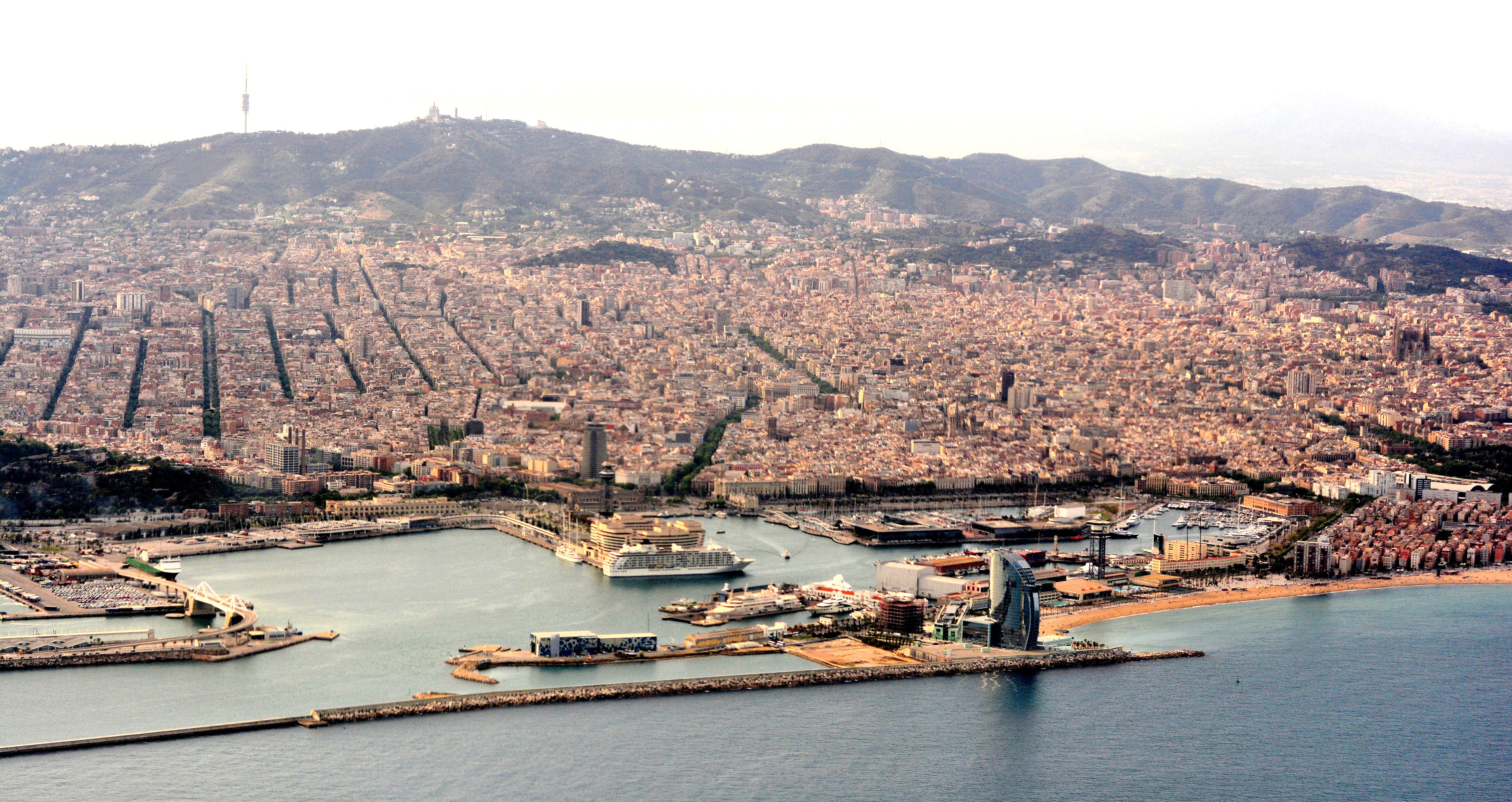
Barcelona is the most-used embarkation port in the Mediterranean. MSC, Costa, Royal Caribbean, NCL, Celebrity, Princess, Virgin and others all sail from it. Most big ships use the Moll Adossat terminals, lettered A to E.
Taxi or rideshare is the easy choice with cruise luggage. The ride takes about 20–30 minutes. Taxis add a fixed port supplement, so budget €35–45 in total.
The Aerobús is the public-transport option, but it only goes to Plaça de Catalunya in the city center. From there you still need a taxi or the port shuttle bus out to Moll Adossat, so with two large suitcases you won't save much over a taxi all the way.
A few ships use the World Trade Center terminals, which are closer to the city. Your cruise documents will say which terminal you need.
Rome: you're really going to Civitavecchia
No large cruise ship docks in Rome itself. The port is Civitavecchia, about 45 miles (70 km) north-west of the city and about 40 miles from Fiumicino (FCO). You have three realistic options.
- Shared shuttle: typically €30–50 per person. You may wait for other passengers to arrive.
- Private transfer: typically €120–180 per vehicle. Ask for the vehicle size and the price for your party and luggage; a family with cruise suitcases may need a van.
- Train: FCO to Roma Termini or Trastevere, then a regional train to Civitavecchia — about 2 hours in total with changes. A free port shuttle bus runs from Civitavecchia station to the ships. Only for travelling light.
Shared or private? A private transfer is worth it when its quote is no more than the shared per-person price multiplied by the number in your group. For two people, shared seats come to €60–100 against a private €120–180, so shared wins. For four, shared comes to €120–200, which overlaps the private range — get a quote for a vehicle that fits everyone's bags, and if it's in line, private also saves the wait.
Rome's other airport, Ciampino (CIA), is mostly low-cost airlines and further from the port, at about 55 miles. Avoid it unless the fare saving is large.
Don't plan to land at FCO on the morning you sail. Fly in the day before and stay in Rome or in Civitavecchia itself. Our guide to flying in the day before a cruise explains how early is enough.
Athens: Piraeus, and occasionally Lavrio
Piraeus is Athens's port, about 28 miles from Athens International Airport (ATH).
Taxi is the simplest way there, at 45–60 minutes. Ask for the fixed fare — about €55–65 in the daytime; ask what the night fare is if you land late. Tell the driver your gate. The usual cruise gates are E11 and E12, but go by your ship's documents.
Metro Line 3 runs from the airport to Piraeus in about 60 minutes. The catch is the 10–20 minute walk from the station to the cruise gates, awkward with big bags; a short taxi from the station solves that.
Express bus X96 also runs airport to Piraeus, but takes about 90 minutes.
Some smaller lines use Lavrio instead, including Celestyal and some Greek-island sailings. Lavrio is about 40 miles south-east of Athens but only about 25 miles from the airport. If your documents say Lavrio, don't book a hotel in Piraeus.
"Venice": check which port before you book flights
Since August 2021, ships over 25,000 gross tons have been banned from the Giudecca canal and St Mark's basin, so big cruise ships no longer dock in Venice proper. Small ships under 25,000 GT can still use the Venice Marittima terminal. Larger ships sold as "Venice" cruises typically embark at one of three ports.
- Porto Marghera, an industrial port on the mainland, about 8 miles (20–30 minutes) from Venice Marco Polo airport (VCE). Some lines use it for mid-size ships. Of the three, it's the only one VCE serves comfortably.
- Ravenna (Porto Corsini), used by Royal Caribbean, Celebrity and others. From VCE it's about 90 miles, 2–2.5 hours south. From Bologna airport (BLQ) it's about 50 miles, 60–75 minutes. Cruise lines sell coach transfers from both.
- Trieste, used by MSC, Costa and others. From VCE it's about 95 miles, 1.75–2 hours east. Trieste's own airport (TRS) is about 25 miles from the port, 30–40 minutes.
The rule for choosing an airport:
- Marghera: fly into VCE.
- Ravenna: check flights into BLQ as well as VCE, and compare the total cost of each, fare plus coach transfer. The closer airport isn't automatically the cheaper trip.
- Trieste: compare TRS with VCE. TRS is much closer, but check whether the fare and connections justify it.
BLQ and TRS are smaller airports than VCE. From the US, expect a connection, and don't assume their fares are close to VCE's. Our planning page can help: "Where can I go?" shows the cheapest recent fares from your home airport, and "Cheapest dates" shows one route by month or day — run home-to-VCE, home-to-BLQ and home-to-TRS separately. These are recent cached prices, not live quotes; if an airport doesn't appear, check a live search before ruling it out.
Whichever airport you choose, fly in the day before.
Getting from VCE into Venice itself matters for a small-ship sailing from Marittima, or if you're spending a day or two in Venice first: the ATVO/ACTV bus to Piazzale Roma (20–30 minutes), the Alilaguna boat to St Mark's (60–75 minutes), or a water taxi (typically €120–140). If you stay in Venice before a sailing from Marghera, Ravenna or Trieste, allow time on sailing day to get back out to the port.
Timing, tickets and passports
Weekends are busiest. Barcelona and Civitavecchia see their heaviest turnaround traffic on Saturdays and Sundays. Allow extra time for your transfer.
One-way cruises usually mean open-jaw flights. Many Mediterranean sailings start in one city and end in another, such as Barcelona to Rome or Athens to Venice. You can book that as a single multi-city ticket or as two one-way tickets; which is cheaper varies by route and airline. Our explainer on why a one-way flight can be cheaper than a round trip covers why, and how far in advance to book international flights covers timing.
Booking flights separately from the cruise. If you book flights yourself, the cruise line generally isn't responsible if a delay makes you miss the ship, and the same applies across separate airline tickets — see missed connections on separate tickets. Buying flights through the cruise line changes what happens if you're late, though terms vary; our comparison of cruise line air packages vs booking your own flights weighs the trade-offs.
If your flight is delayed or cancelled, see your rights when a flight is cancelled or badly delayed. EU261 covers flights departing the EU and flights arriving in the EU on an EU airline, so a US airline flying you into Barcelona or Rome isn't covered on that inbound leg — see how EU261 compensation works. Bear in mind that EU261 compensates you for the flight, not for the missed ship; cover for a missed departure comes from travel insurance, which our services page outlines.
Documents for US passport holders. US citizens don't need a visa for stays of up to 90 days in the Schengen area, which includes Spain, Italy and Greece. ETIAS, the European travel authorization, will need to be applied for online before you go once it is in force; check travel-europe.europa.eu/etias for the current status. Your passport must be valid for at least 3 months after you leave the Schengen area — our passport validity checker handles that — and must have been issued within the last 10 years, which you check on the photo page yourself. See also the six-month passport rule, explained. Other nationalities should use the entry-requirements lookup on the same documents page.
When to sail. The main season runs roughly April to October, with repositioning cruises — one-way sailings that move a ship between regions — in spring and autumn.
If you haven't booked your sailing yet, our sister site bestcruising.com books cruises and cruise packages (not flights), with agents available by phone and email for questions about a booking. Your cruise documents are the final word on which port you sail from.
Frequently asked questions
Can I fly in and sail the same day?
Don't, at any of these ports; fly in the day before. The transfers are long enough that one delay costs you the sailing: Civitavecchia is 60–90 minutes from FCO; Ravenna is 2–2.5 hours from VCE or 60–75 minutes from Bologna; Trieste is up to 2 hours from VCE or 30–40 minutes from its own airport; and BLQ and TRS usually mean a connecting flight from the US. Barcelona's 20–30 minute transfer gives more slack, but it won't help if your flight is badly late or cancelled.
Which airport should I use for a "Venice" cruise from Ravenna?
Often Bologna (BLQ), about 50 miles or 60–75 minutes from Ravenna, against VCE's 90 miles and 2–2.5 hours. BLQ is a smaller airport, so from the US you'll likely need a connection. Compare the total cost of each option, fare plus coach transfer, before you decide.
Which airports suit a one-way Barcelona-to-Rome cruise?
Fly into Barcelona (BCN) and home from Rome Fiumicino (FCO), as a multi-city ticket or two one-ways, whichever is cheaper. Avoid Ciampino (CIA) for the trip home unless the savings are large, because it's further from Civitavecchia.
Is the metro a good way to reach the ships in Piraeus?
Only if you're travelling light. Metro Line 3 takes about an hour from the airport, and the final walk to the cruise gates is another 10–20 minutes. With full cruise luggage, a fixed-fare taxi is far easier.